- Print Magazine
- Digital Magazine
- Newsletter


Advertisement
Latest News

Once again, Walmart landed at the top of the National Retail Federation’s Top 100 Retailers list, racking up $568.7 billion in total U.S. sales last year, up 7% from 2023. The retail juggernaut seems poised for similar success in 2025, recently raising expectations for net sales growth during the fiscal year to 3.75% to 4.75%. But in Q2, the Bentonville, Ark.- based chain missed earnings expectations for the first time since May 2022, leading some to wonder whether rising costs associated with tariffs combined with the company’s efforts to avoid passing those costs along to consumers battered by inflation might finally be taking a toll.
During a second quarter earnings call, CEO Doug McMillon said Walmart rolled back prices on a whopping 7,400 items during Q2 — 2,000 more than last year. And in the grocery category, rollbacks increased 30% year-over-year, easing some of the pressure on shoppers keeping a tighter grip on their wallets. Although boosting investment in prices may have temporarily impacted the bottom line, industry observers think it was a shrewd move on Walmart’s part.
“A central element of Walmart’s success is its low price promise,” explains Neil Saunders, managing director of retail at New York-based GlobalData. “Consumers shop there because they can save money and make their dollars go further. So Walmart has to keep that promise, come what may…. A short-term miss on earnings is acceptable if it preserves the long-term brand promise of Walmart.” He adds that lowering prices now when consumers are laser-focused on value is especially important “because there are a lot of other low-price players like Aldi snapping at Walmart’s heels.”
“Aldi in particular has been very successful in establishing a notable price gap in its grocery assortment, and customers are responding very positively,” confirms Karen Kelso, vp of mass and club at New York-based Kantar. And it isn’t the only threat. “As the economy becomes more unpredictable and inflation hits grocery categories, shoppers at all income levels are trading down to both the value channel and the dollar channel. But rollbacks help reinforce the perception of Walmart as the low price leader.”
“It may not be a checkmate move, but it certainly is keeping them in the game,” says Gavin Stoecker, principal consultant at Cadent Consulting Group, Evanston, Ill. That said, he continues, doubling down on rollbacks could have unintended consequences. “Push too far, and Walmart risks diluting its EDLP positioning,” Stoecker explains.
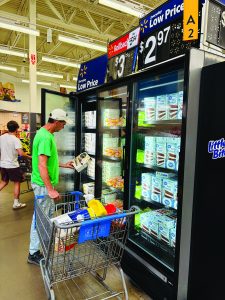
Despite rising costs, Walmart increased grocery rollbacks 30% in Q2, helping solidify its reputation as the low price leader.
But consumers aren’t just trading down, they’re also shopping more channels than ever, often visiting several different retailers in an effort to find the lowest prices in each category. That shift carries a bigger threat to Walmart than traditional supermarkets because it dilutes the potency of another of the chain’s biggest strengths: onestop shopping. However, says Stoecker, Walmart’s frozen and refrigerated departments are helping slow the leakage to other formats.
“Walmart takes a very balanced approach,” he explains. “Costco may win on value. Trader Joe’s may win on experience. And traditional grocery may win on variety. But Walmart does enough to compete with all three. That means it may not stock 50 brands of frozen pizza, but it is going to be very smart about which brands it carries to maximize perceived variety.”
Saunders, too, believes the “comprehensiveness” of Walmart’s offer in frozen and refrigerated is helping it retain shoppers. “It has a very wide selection, which allows customers to trade up or down as they need or want,” he explains. “In a category like ice cream, for example, consumers can indulge in more premium brands or they can save money on one of Walmart’s private label brands. You can basically go to Walmart and know that you’ll find what you need.”
Nowhere is the breadth of Walmart’s offer more visible than in the frozen meals category, says Stoecker. “This is a segment where convenience has always been critical, but the value equation is shifting toward quality options with strong nutrition. Walmart has pushed the envelope with chef-inspired or celebrity-backed meals, plant-based options, ethnic meals, and a strong presence from its bettergoods brand, offering fun, intriguing flavors at an affordable price.” He adds, “The chain also offers a strong mix of value-size and single-serve options, recognizing that these meals can meet vastly different consumer needs and provide cost-saving in different ways.”
One of the hallmarks of Walmart’s frozen meal set is the presence of new brands exclusive to the chain (at least temporarily), including several of the aforementioned celebrity chef brands (think Guy Fieri, Gordon Ramsay and Esther Choi), not only differentiating it from competitors but creating a bit of excitement as well.
“Whenever possible, Walmart wants to the first-tomarket, to be the retailer where customers find new, innovative and exclusive products,” says Kelso, who calls it a smart move. “Research shows that customers are highly likely to become repeat purchasers at retailers where they initially found a new product,” she explains. So Walmart is locking in customers for the longer term.

From Pistachio & Almond Gelato and Salsa Verde Hash Brown Breakfast Sandwiches to Beef Bulgogi Empanadas and Custard-Filled Waffles, the “aspirational” bettergoods lineup includes a wide variety of innovative, fun foods — many priced under $5.
Given the volumes Walmart can drive, suppliers are only too happy to offer exclusivity on new items, says Perry Kramer, managing partner at Boston-based Retail Consulting Partners. “It can also leverage its broad set of customer data to work collaboratively with CPG firms on joint development efforts,” he adds.
Isn’t it a little risky to take on so many unproven new items? Perhaps. But the stability of Walmart’s core business gives it room to take a few chances. Moreover, says Stoecker, “Walmart is increasingly data-driven and fueled by consumer research. So when it takes a risk, it’s probably far less risky than it appears.”
Despite the uniqueness of the chain’s offer in categories such as frozen meals, desserts and ice cream, where Van Leeuwen’s Walmart-exclusive limited-edition flavors are the stuff of legend, other frozen and refrigerated assortments are a bit more pedestrian. As a result, “I do see opportunities to take bigger, long-term swings that can shape the market,” says Visudha Cidambi, business analyst at Cadent Consulting. “In many categories, Walmart takes a more cautious approach, following trends rather than leading.”
While Walmart is bringing in more innovative national brand products, it’s also expanding its own brand offerings. “Private label is becoming a bigger part of Walmart’s business, increasing its share by 1% during each of the last few years following a big spike in 2023,” reports Kelso. “Growth is being driven partly by economic constraints, partly by the increased quality of private label options and partly by declines in brand loyalty, particularly among younger consumers.” But it’s clear that the company’s new bettergoods lineup also plays an important role, filling out its multi-tiered strategy with a more upscale offer that also provides a vehicle for unique own brand items.
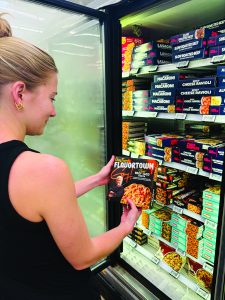
Exclusive brands from celebrity chefs such as Gordon Ramsay and Guy Fieri have helped elevate Walmart’s frozen meals assortment — and also helped differentiate the chain from competitors.
“Since bettergoods is positioned as more premium and aspirational, the brand is coming into categories that are considered family dinner staples such as pizza (e.g. cauliflower crust pizza) and frozen meals (e.g. gluten-free broccoli cheddar bakes) as well as indulgent desserts (e.g. salted caramel peanut crunch gelato),” says Kelso. “Walmart is squarely aiming for a Trader Joe’s-type of assortment and looking to grow spend with higher-income customers,” a long-term goal of the company, she adds.
So far, it appears to be working, according to Cidambi, who says bettergoods represents “a new evolution” in store brands. “Walmart is not the first retailer to use private label for innovative, fun, quality products at a good value,” she explains. “But they are doing it at immense scale and are clearly dialed into consumer trends.” She adds, “By all accounts, shopper repeat and loyalty has been very positive for this brand, which is rapidly gaining space in-store, which we expect to continue.”
As a result, says Stoecker, national brands that compete in categories where bettergoods has a strong presence, including frozen meals and frozen desserts, are feeling “significant pressure.” For those brands to be successful, he says, “Strong alignment with Walmart on the role they can play — and then tailoring products to fit that role — will be critical.”
In certain categories, continues Stoecker, the chain has essentially flipped the script. “Walmart is strategically using bettergoods to offer flavor innovation, which has traditionally been a role for national brands, with a low cost structure and greater agility to meet changing consumer preferences.”
But that doesn’t mean national brands are any less relevant, says Saunders. Yes, Walmart is placing more emphasis on private brands, but at the same time, it’s doing more with national brands, especially newer and more innovative offerings. “It’s not an either/or at Walmart; it’s about doing both,” he says. While competitive pricing remains at the heart of Walmart’s offer, says Saunders, “It’s also saying to consumers that they can come there for more premium things as well. And both private label and national brands are playing a role in stretching the price architecture.”
Having a multi-tiered strategy, including a robust “upper-middle” tier as some characterize bettergoods “appears to be resonating well and has opened the door for a wider, more nuanced mix of private label throughout the store,” says Stoecker, citing both the Marketside and Great Value brands as well. “Walmart has invested heavily in branding elements for all of these product lines, and it is paying off,” he adds.

Remodeled Walmarts feature special sections for single-serve grab-and-go items and fresh meal solutions, while older stores take a more traditional approach to merchandising, leading to inconsistent experiences from location to location.
Between exclusives, own brands and other products that align with emerging consumer needs, “Walmart’s frozen and refrigerated departments are solid,” says Saunders. “However, there should probably be more inspiration in parts — small areas to highlight things like evening meals, special occasion products and new and innovative foods. Walmart’s frozen and refrigerated departments are so large, so breaking up the monotony is important.” But it’s not only about aesthetics, he adds. “It’s about moving beyond replenishment shopping, which Walmart is very good at, to more mission-driven shopping and impulse buying.”
Kramer agrees, suggesting more signage highlighting nutrition and attributes such as plant-based and gluten-free — as well as better segregation of products in frozen planogramming — would likely produce “a notable sales lift.” (But 2D barcodes that give consumers access to product information and also help retailers track products and manage inventory would be even better). He would also like to see more local products or at least a better attempt to call out the ones Walmart already offers.
Another area that could use some attention is stocking. “Having recently shopped several stores…I was surprised and slightly disappointed by the large number of outof-stocks in the frozen and refrigerated sections,” says Kramer. “Almost every case had several very large holes in the stock presentation.”
Stoecker, on the other hand, believes Walmart has already made significant improvements to the shopping experience, citing remodeled stores, clearer signage and navigation, cleaner aisles, better execution of merchandising, strong product facings and other advances. “When walking a frozen or refrigerated section at Walmart today [versus a few years ago]…the transformation has been quietly remarkable,” he says.
Clearly, the experience can vary widely from location to location. “Not every Walmart is created equal, and shoppers don’t always know what to expect when visiting a store,” explains Cidambi, who says creating a more consistent experience across locations represents a “major challenge” for the chain. “Walmart is investing here, but it may take time for broad consumer perception to catch up.”
In stores that have already been remodeled, “Walmart has done a nice job tailoring their sections to real consumer occasions: specific meal parts (e.g., breakfast, dinner, snacks), grab-and-go refrigerated sections, freezer staples, cross-merchandising moments, etc.” He adds, “Walmart has a strong understanding of the shopper basket and shapes its aisles to facilitate a smooth experience.”

Endcaps are often used to showcase rollback prices, but industry observers would like to see Walmart display innovative new items as well.
That said, Stoecker believes the chain could do a better job communicating some of the changes it’s made recently. “Walmart has invested in an improved experience and fun, new product lines that have been a delightful surprise to existing shoppers,” he explains. But unless they’re already in the Walmart ecosystem, “I don’t think most consumers are aware of the improvements. I just think Walmart is really focused on communicating value, leaving some of these secondary elements to fall by the wayside.”
While communicating improvements externally is a clear opportunity to attract new customers, Stoecker says Walmart could also improve messaging around changes to existing customers in-store. For example, while endcaps are currently used to display both EDLP products and rollbacks, “I’d love to see them used to showcase unique new items rather than just expecting consumers to uncover them while they’re shopping in the section,” he says.
Some of the best news to come out of Walmart’s Q2 earnings report is the growth of online sales, up 26% year-over-year — with a third of those orders expedited. “E-commerce is immensely important, especially in frozen, where convenience is top of mind,” says Cidambi. “As improvements in cold chain logistics have opened the door to better frozen and refrigerated pick-up and delivery, this will be a critical segment to win online.” She adds, “Walmart is ahead of the curve and this could serve their frozen and refrigerated business — and broader grocery — very well in the long run.”

As Walmart doubles down on grocery rollbacks, even organic eggs are affordable.
One signal that consumers plan to purchase more groceries online is the surge in Walmart+ subscriptions. In its August consumer survey, Worthington, Ohio-based Prosper Insights & Analytics asked shoppers from across the country whether they have a Walmart+ membership. Among those who say they do the majority of their grocery shopping at Walmart, 39.6% have a Walmart+ membership versus 25.1% of all respondents. Among Walmart shoppers, 63.3% say the primary reason they subscribe is for free same-day grocery delivery (compared to 54.3% of all respondents). It’s worth noting that Amazon announced in August that it, too, will now offer members free same-day delivery of perishables in more than 1,000 locales nationwide, which suggests that Walmart is, indeed, ahead of the curve.
“What Walmart needs to do is keep adding bells and whistles to make the program stickier — a bit like Amazon has done,” says Saunders. What about using the shopper data it collects to tailor offers? “Personalized offers can be helpful, but Walmart has to take care as it needs to retain its EDLP position rather than offering different prices and deals for different customers,” he answers. “That said, Walmart+ can link manufacturers to Walmart customers via the retail media arm, so it’s a useful vehicle for promotions.”
In addition, says Cidambi, “Walmart is investing in adaptive retail to personalize the shopping experience and build convenience. Early applications are more focused around clothing and furniture, but the long-term potential for food and beverage is immense, both for impulse purchases and basket building.”
Stoecker adds, “Walmart is quickly becoming a data powerhouse. I don’t think we’ve seen the full power from a consumer-facing perspective yet (e.g., offers, media), but it is fueling a real transformation behind the scenes.”

Walmart has added more products with modern attributes such as gluten-free and plant-based, especially under its new bettergoods private brand.
So what’s next for Walmart? “The chain performs well in times of economic difficulty, and 2026 will be no exception,” says Kelso. However, “I believe that tariffs will impact Walmart in unexpected ways. Small businesses are the backbone of its marketplace and I don’t believe that many small businesses can survive the extremes of tariff uncertainties and increased costs.” In addition, she says, “Customers will be under increasing pressure in 2026 (loss of SNAP, Medicaid) and will be most likely to go to dollar stores to buy just enough of what they need to get them to their next paycheck.
“Walmart has been very successful in the past few years,” continues Kelso. “But success can build complacency and/or an unwillingness to change. I believe that what got Walmart to where it is now is not necessarily enough to successfully deal with the unprecedented scope and scale of change coming.”
Saunders believes the chain has already begun positioning itself for a new reality. “Walmart has given itself permission to be more aspirational,” he explains. “By investing in new stores, new brands, new marketing and new channels such as its marketplace, Walmart is making a lot of consumers take another look and is winning share of shoppers and spend.” He adds, “Walmart knows that while price is important, what consumers are really looking for is great value, and that means moving beyond basic things.”
Advertisement






Advertisement

#1 IN AD REVENUE
TARGETED READERS
AWARD WINNING
