


- Print Magazine
- Digital Magazine
- Newsletter

Advertisement

Category Spotlights

Total dollars are down, but the premium, humanely raised eggs segment continues to heat up. Are you giving these growth-drivers enough space – and educating shoppers on the differences?
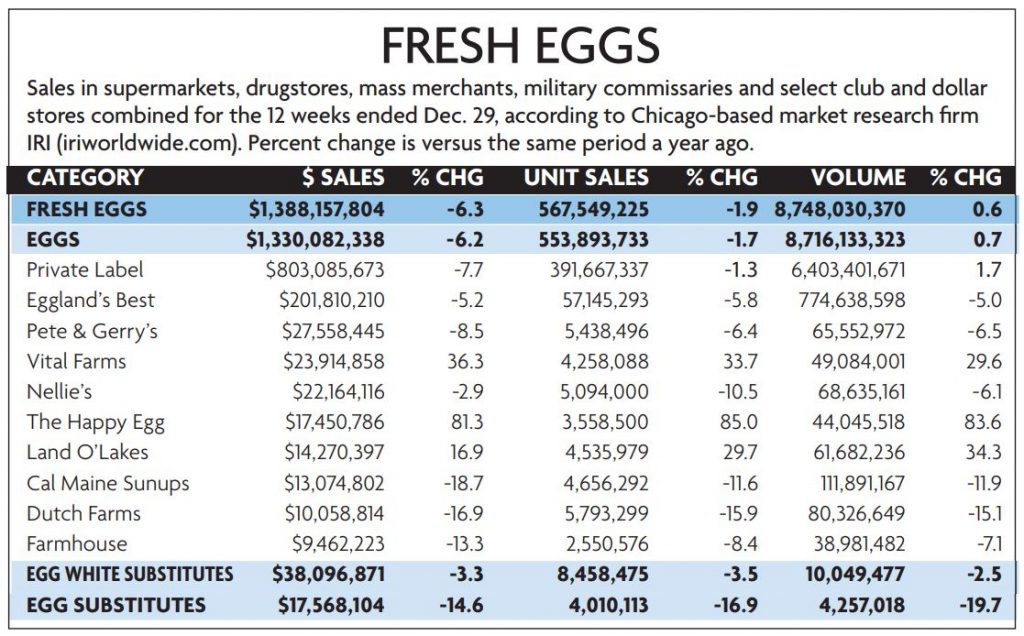
After holiday egg prices dipped “as low as they’ve been in decades,” it’s no surprise dollar sales during the 12 weeks ended Dec. 29 were down 6.3% to $1.39 billion across channels, according to Chicago-based market research firm IRI (iriworldwide.com). “There is simply too much supply in the market as cage-free facilities have come online in preparation for upcoming transitions, and older caged facilities have remained in production,” explains Paul Turbeville, VP of marketing at Monroe, N.H.-based Pete & Gerry’s (peteandgerrys.com).
On the plus side, however, consumers are eating more eggs. IRI reports volume was up 0.6% during the most recent 12 weeks. And the American Egg Board (AEB) projects per capita consumption will hit a seven-year high 293.3 this year. But it’s not only because eggs are so cheap. A staple of several popular diet plans (keto, paleo, etc.), eggs also tap into demand for clean, simple foods that offer functional nutritional benefits. “Many consumers have turned to the egg category to supplement their grocery baskets with whole, unprocessed ingredients,” says Sotheary Hom, marketing manager at Denver-based NestFresh (nestfresh.com).
Pasture-raised Heirloom Eggs from NestFresh are Certified Humane, highlighting growing demand for
third-party verification.
However, many shoppers expect even more from their food, which is driving strong growth among more humanely sourced eggs – “the lone bright spot in an otherwise
difficult category,” according to Turbeville. During the 52 weeks ended Dec. 29, dollar sales of commodity caged and caged specialty eggs fell 16.0% and 9.5%, respectively, while those labeled, simply, “cage-free” were down 9.1%, thanks to consumers’ growing realization that, on its own, the term doesn’t mean what they thought it did. However, sales of more humanely raised cage-free eggs (from hens given outdoor access), including organic, free-range and pasture-raised products, jumped 0.9%, 23.4% and 39.1%, respectively.
“Consumers are becoming more mindful of where their food comes from and more considerate of ethical production practices,” explains Kathryn McKeon, director of marketing at Vital Farms (vitalfarms.com), an Austin, Texas-based producer of pasture-raised eggs that just launched a ground-breaking traceability initiative. “Now, every Vital Farms consumers can see the small family farm where their eggs were laid with a full 360-degree tour of the pasture.” She adds, “Consumer response has been overwhelmingly positive.”
The popularity of ethical eggs is good news for retailers, too. “While cage-free eggs represent between 12% and 15% of retail volume sales, they bring in between 25% and 30% of all retail dollar sales,” with the humanely raised varieties contributing a disproportionate amount, reports AEB’s vp of marketing Sofia Therios.
As a result, says Turbeville, “The goal for most retailers should be to trade up as many consumers as possible to premium eggs, which enjoy stable pricing and more sticky consumers.” He adds, “Retailers that have focused on premium eggs are faring much better in this difficult commodity market than those focused solely on driving store traffic with cheap eggs.”
“We often see shoppers with baskets full of national brand items go and pick up commodity eggs because they simply aren’t aware that there’s a better choice,” says Dan Arnsperger, CEO of Happy Egg Co. (happyegg.com), Rogers, Ark., which posted a category-leading 81.3% gain during the most recent 12 weeks. But once they discover they have options, they’re eager to trade up. “Consumers who can buy commodity eggs for less than a dollar a dozen are choosing to pay five times more for better-foryou products like ours that align with their values around animal welfare.” Even at that price, he adds, “Premium eggs are an affordable luxury.”

New Heritage Breed eggs from Happy Egg — the first Whole30 Approved egg brand — are ‘100% incremental’ to the category.
For most consumers, says Arnsperger, the sweet spot lies at the intersection of organic and ethically raised/ outdoor access, i.e. free-range or pasture-raised, so that’s where Happy Egg is focusing its efforts. However, the company has had great success recently with its new free- range heritage breed eggs. “With beautiful blue and brown shells and gorgeous amber yolks, they’re the best-tasting eggs you’ll ever have,” he says. Only about 20% of retailers carry heritage eggs – and Happy Egg is completely sold out of its supply – but the premium product has been a big hit everywhere it’s offered, from high-end supermarkets to mainstream retailers (even Walmart). “And they’re totally incremental to the category,” says Arnsperger. Not unlike, say, the butter category, “Consumers have told us that they’ve started to buy multiple types of eggs – regular for everyday and heritage for more special occasions or dishes. So they’re a great way to grow the category.”
Another boost is expected from Happy Egg’s recent designation as the industry’s first Whole30 Approved egg brand (the certification requires manufacturers meet minimum standards around animal welfare as well as ingredients). “It’s a big deal,” claims Arnsberger, who says devotees of popular diets often struggle to find products compatible with the plan.
The announcement highlights the increasing importance of third-party certifications in the egg category where consumer understanding around various claims is still somewhat hazy. “Third-party certifications not only allow shoppers to feel as though they can trust the brands they’re buying but also direct them to quality – and qualified – third-party resources that ultimately define and verify their standards for producing food,” says NestFresh’s Hom. She adds that the newest addition to the company’s lineup, Pasture Raised Heirloom Eggs, is Certified Humane by Humane Farm Animal Care.
Beyond heritage/heirloom eggs and the occasional duck or quail egg SKU, there hasn’t been a lot of new product activity in the category lately. In fact, it appears most manufacturers are looking for opportunities outside the shell eggs segment, particularly in the hard-cooked arena. Although hard-cooked eggs represent only about 1.1% of the retail egg category, volume rose 7.6% during the 52 weeks ended Dec. 29, while dollars jumped 8.1% (to $167.53 million). One of the newest entries, a single-serve grab-and-go option from NestFresh, comes with a bamboo fork so consumers can stick the egg and then dip it into the included sauce or seasoning. (Read more about NestFresh Egg Pops in our cover story.)
Manufacturers are also eyeing opportunities in the on-the-go breakfast segment. For example, La Farge, Wis.-based Organic Valley (organic valley.coop) will launch “first-of-their- kind” Egg Bites in July, reports Jason Naylor, marketing director of meat, cheese and eggs. Although he’s unable to share more details, “The product is made for people who want a fast, organic breakfast,” says Naylor, who sees a trend toward more prepared solutions. “And it will be the only organic product in the competitive set.”
Pete & Gerry’s is also debuting ready-to-eat sousvide egg bites this year under its Nellie’s brand, reports Turbeville. Made with certified humane raised free-range eggs, the refrigerated product will be available in three flavors: Smoked Ham & Swiss; Spinach, Artichoke & Gruyere, and Bacon, Jalapeno & Cheddar. Each 4.2-ounce package will contain two egg bites.
While premium eggs are driving growth in the category, manufacturers say sales have the potential to go much higher if consumers are made to understand the differences between the various types. A lot of that education needs to happen at the shelf. But suppliers can put so much information on the package. Whether they do it on their own or in conjunction with a partner, “Retailers that have invested in shelf education overwhelmingly win,” says Arnsperger.
“If consumers are informed, they generally are willing to pay a premium for higher standards,” adds Naylor. “But there’s lots of confusion around hen care standards in premium.”
“Simple signs and channel strips that define cage-free, free-range, organic and pasture-raised in particular will help shoppers make a selection that lines up best with what they value,” continues Hom. Retailers can also use their social media and digital communication vehicles to provide additional details, even about the farms where various eggs are sourced. “Consumers long for a connection to their food and crave more information about how it’s produced,” she says.
Beyond simply clarifying differences between the various types of eggs, “Retailers should also help educate consumers on the benefits of eggs – high protein, low-cal, no carbs, etc.,” says Ryan Miller, co-owner and general manager at Farmer’s Hen House (farmershenhouse. com), Kalona, Iowa. And although eggs are usually associated with breakfast, “Retailers could pair them with other items instead of just bacon and sausage.” Think hard-cooked eggs with salad and shell eggs with burgers and other sandwiches.
Retailers should also consider tweaking their assortments. Bringing on ample premium varieties, particularly those with outdoor access, is a no-brainer. But Arnsperger says category managers might also look at cutting back on size variety (jumbo, large, medium, etc.). “Consumers tell us they only buy a size other than large by accident. So assortment of sizes isn’t driving sales as much as brands that align with their values,” he explains.
However, variety is important when it comes to package count. While sales of traditional dozens were down 2.6% in 2019, sales of 18-, 24- and 60-count packages were up 3.8%, 5.5% and 14.7%, respectively, according to figures supplied by AEB.
Sales in supermarkets, drugstores, mass merchants, military commissaries and select club and dollar stores combined for the 12 weeks ended Dec. 29, according to Chicago-based market research firm IRI (iriworldwide.com). Percent change is versus the same period a year ago.
View Article in Digital Magazine
[hr]
[dflip id=”11813″ type=”thumb” ][/dflip]
View PDF
[hr]
Advertisement






Advertisement

#1 IN AD REVENUE
TARGETED READERS
AWARD WINNING
